
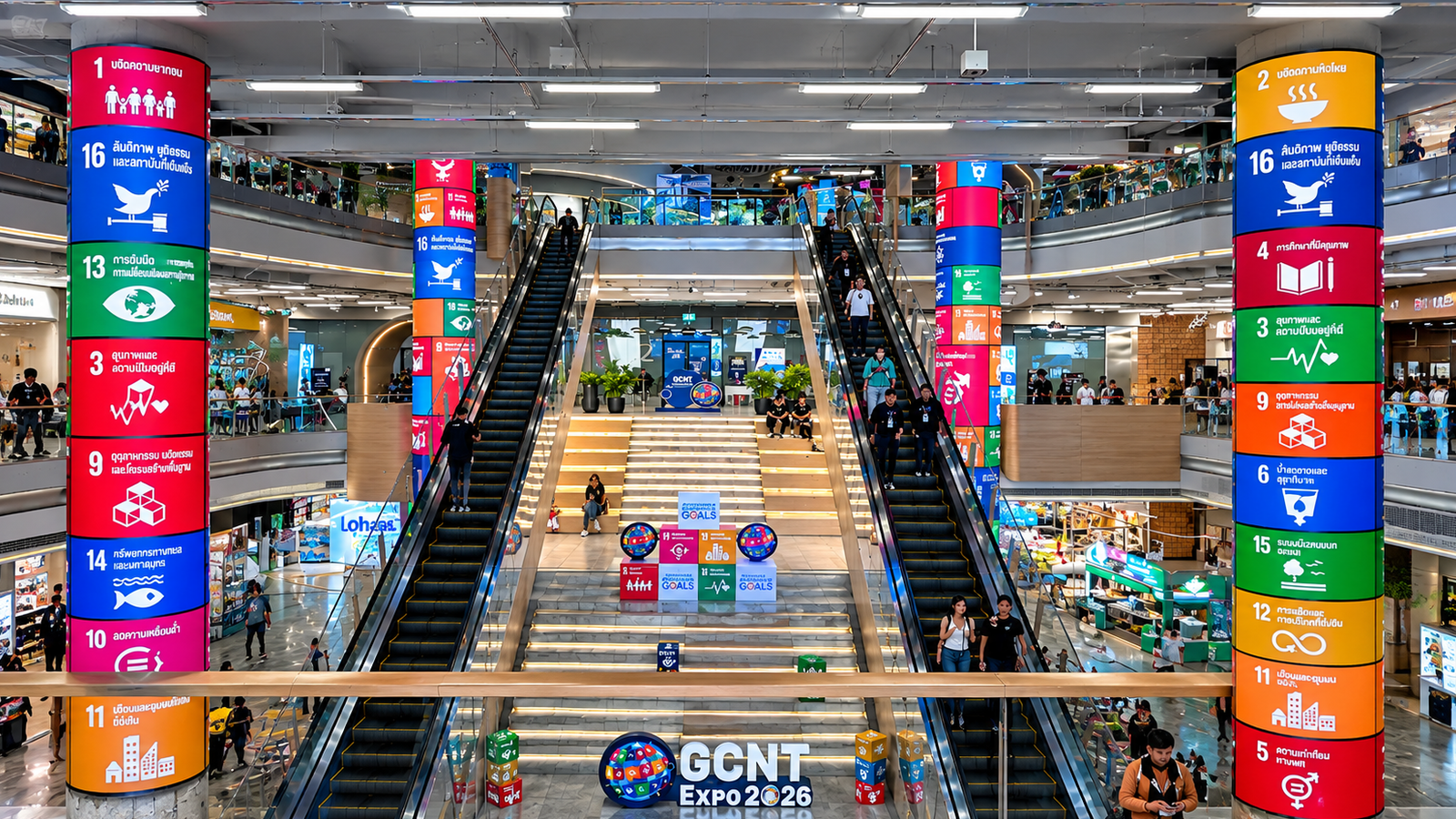
Introduction: Global Crisis & Thailand’s Imperative
In an era defined by geopolitical turmoil, supply chain disruptions, and accelerating climate disasters, driving the Sustainable Development Goals (SDGs) is no longer an optional PR tactic for large corporations. It represents the sole survival strategy for Thailand’s economy, society, and natural ecosystems.
For decades, sustainability was treated as an ancillary concern, a line item to be addressed once profit targets were secured. That era has ended. Today, the forces reshaping global trade, finance, and diplomacy are converging on a single demand: nations and businesses that fail to decarbonize, adapt, and protect their people will be locked out of the markets, capital, and partnerships that define twenty-first-century prosperity. For Thailand, a country whose GDP is deeply intertwined with manufacturing exports, agriculture, and tourism, this is not an abstract international debate. It is a direct test of national resilience, and the outcome will determine whether the country thrives in the coming decade or is left behind by it.
Section 1 — The “Shock”: A Fractured World and Thailand’s Challenge
The world is caught in a Polycrisis, where environmental shocks intersect with stringent trade policies such as the European Union’s Carbon Border Adjustment Mechanism (CBAM). As an export- and tourism-reliant nation, Thailand faces direct vulnerability across its economic foundations. Rising sea temperatures disrupt fisheries and coral-reef tourism; erratic monsoon patterns threaten rice, sugarcane, and cassava yields; and prolonged droughts strain the water resources on which both agriculture and industry depend. Layered on top of these physical shocks is a rapidly shifting regulatory landscape, in which importing nations are redesigning trade rules around carbon content, labor standards, and supply-chain transparency.
This is the essence of the Polycrisis: no single shock arrives in isolation. A drought that depresses agricultural output simultaneously weakens rural household income, reduces export volumes, and increases the carbon intensity of remaining production per unit of output — precisely the metric that mechanisms like CBAM penalize. Thailand’s economic model, built over decades around low-cost manufacturing and high-volume exports, was never designed to withstand this kind of compounding pressure. The result is a widening gap between how the Thai economy currently operates and how it must operate to remain competitive and stable.
3 Core Challenges Facing Thailand
1. Carbon Tariffs & Compliance: Exporters face severe cost penalties without rapid decarbonization. CBAM and similar mechanisms effectively convert carbon emissions into a direct line-item cost at the border, meaning that Thai steel, cement, aluminium, and other carbon-intensive exporters must now compete not only on price and quality but on the carbon footprint embedded in every shipment. Firms that delay investment in cleaner production risk losing market access altogether, not merely facing higher costs.
2. SME Constraints: Over 80% of small enterprises lack carbon accounting tools and green financing options. Small and medium-sized enterprises form the backbone of Thailand’s economy and employment base, yet most lack the technical capacity to measure their emissions, the financial literacy to access green loans, or the capital reserves to absorb the upfront cost of cleaner equipment. Without targeted support, the transition risks becoming a filter that only large corporations can pass through, hollowing out the SME sector that sustains millions of livelihoods.
3. Inequality & Climate Vulnerability: Agricultural workers and low-income groups bear the heaviest burden of severe weather events (SDG 1 & 10). Those with the least financial cushion are consistently the first to lose income when floods destroy crops or heatwaves halt outdoor labor, and the last to receive relief or rebuilding support. Left unaddressed, the sustainability transition risks widening — rather than narrowing — the inequality it is meant to help resolve.
The Global Compact Network Thailand (GCNT) acts as a pivotal catalyst uniting business, government, and youth to implement measurable sustainability solutions (SDG 17: Partnerships for the Goals). By convening actors who rarely share the same table — multinational exporters, rural cooperatives, policymakers, and student innovators — GCNT creates the connective tissue needed to turn fragmented efforts into a coordinated national response.
Section 2 — The “Shift”: End of Greenwashing & Youth Leadership
Core Thesis: Superficial ESG rhetoric and greenwashing must be eradicated
For years, organizations treated sustainability as a marketing ornament. In 2026, greenwashing poses legal liability and destroys consumer trust. Without genuine structural adaptation, Thai businesses will be excluded from global value chains. Genuine sustainability must be verified by transparent data and real societal impact.
Some may argue that ESG reporting requirements are an unfair burden imposed by wealthier economies on developing nations still working to industrialize, and that Thailand should focus first on growth before layering on additional compliance costs. This argument misreads the direction of travel. Global capital, insurance, and procurement decisions are already re-pricing risk around climate and governance factors; the cost of inaction is not deferred, it is compounding. Delaying the transition does not protect Thai competitiveness — it guarantees that the country adapts later, at higher cost, and from a weaker negotiating position. The choice is not between growth and sustainability; it is between a managed transition today and a forced, disorderly one tomorrow.
3 Drivers of Genuine Transformation
- From Passive to Active: Youth are active co-creators of policy and technological innovation, not passive recipients of decisions made on their behalf. Programs such as the SDGs Young Creator initiative demonstrate that when young people are given a genuine platform, they generate solutions — from carbon-tracking applications to community recycling models — that are often more agile and locally grounded than top-down corporate strategies.
- ESG as Core Strategy: Reframing ESG from a business cost into value creation. Companies that integrate environmental and social governance into their core strategy, rather than bolting it on as a compliance exercise, unlock new revenue streams, attract long-term investors, and build the operational resilience needed to withstand supply-chain shocks.
- Just Transition: Protecting vulnerable workers and communities during the green transition — no one left behind. A just transition requires deliberate investment in reskilling, social safety nets, and inclusive decision-making, ensuring that the workers and communities most exposed to climate risk are also the first to benefit from the new green economy, not the last.
Section 3 — Sustainability Blueprint: 4 Action Pillars for Thailand
Derived from GCNT Expo 2026, Thailand’s actionable roadmap rests on four interlocking pillars. Each pillar addresses a distinct dimension of the transition, yet none can succeed in isolation — clean energy investment depends on a skilled green workforce, circular-economy innovation depends on capital and policy support, and every pillar depends on the partnerships that translate ambition into implementation.
| SDGs | Action |
|---|---|
| Climate Action & Clean Energy (SDG 7 & 13) | Transitioning to renewables and smart infrastructure to achieve Net Zero by 2050. This includes scaling solar and wind capacity, modernizing the national grid, and incentivizing energy efficiency across industry and the built environment, so that decarbonization becomes an engine of investment rather than a regulatory burden. |
| Innovation & Circular Economy (SDG 9 & 12) | Applying AI, IoT, and BCG (Bio-Circular-Green) models to turn industrial waste into high-value resources. By treating waste streams as untapped raw material, Thai industry can reduce both its environmental footprint and its exposure to volatile global commodity prices, while creating new categories of green manufacturing jobs. |
| Decent Work & Green Jobs (SDG 8) | Creating green employment and upskilling workers for the sustainable economy. This means embedding climate and sustainability competencies into vocational training and higher education now, so the workforce is ready for green industries before demand for those skills peaks, rather than scrambling to catch up afterward. |
| Partnerships for the Goals (SDG 17) | Fostering multi-stakeholder coalitions across private, public, and youth sectors. No single actor — government, business, or civil society — holds all the resources, data, or legitimacy needed to drive this transition alone; durable progress depends on coalitions that share risk, knowledge, and accountability. |
Section 4 — From Vision to Action: What Thailand Must Do Now
A blueprint alone changes nothing without deliberate, coordinated execution. Turning these four pillars into measurable national progress requires clear roles for each major stakeholder group in Thai society.
1. Government: Accelerate the rollout of green financing mechanisms and carbon-accounting support specifically designed for SMEs, and align domestic regulation with international standards so that Thai exporters are not caught unprepared by future trade requirements.
2. Private Sector: Move beyond voluntary sustainability reports toward independently verified, transparent disclosure of emissions and social impact, treating ESG performance as a driver of long-term competitiveness rather than a communications exercise.
3. Youth & Civil Society: Continue to build and scale grassroots innovations — from community-level circular economy projects to digital carbon-literacy tools — and demand a permanent seat at the policymaking table, not a symbolic one.
Executed together, these actions convert the abstract language of the SDGs into a concrete national strategy — one where climate resilience, economic competitiveness, and social equity reinforce one another rather than compete for the same limited resources.
Conclusion & Youth Manifesto
“The future does not happen by chance; it is shaped by our actions today.”
Thailand stands at a genuine inflection point. The shocks of a fractured world — carbon tariffs, climate volatility, and deepening inequality — are not distant threats but present realities already reshaping the country’s economy and communities. Yet within this disruption lies an opportunity: to rebuild Thailand’s growth model around resilience, transparency, and shared prosperity, rather than simply returning to business as usual.
Moving from Shock to Shift is the shared mandate of all SDGs Young Creators — empowering our society through creativity, communication, and decisive action for Thailand’s sustainable tomorrow. The transition will not be led by any single ministry, corporation, or generation alone; it will be built collectively, one accountable decision at a time, starting now.
Contributors
- Team NEXT MOVE for SDGs
- Phuthanate Sudsarn, Khon Kaen University
- Pimonpan Subpok, Khon Kaen University
- Nuchsara Santhirach, Khon Kaen University
- Anaphat Vongkanthai, Khon Kaen University
- Natthida Phinitkanchai, Khon Kaen University