
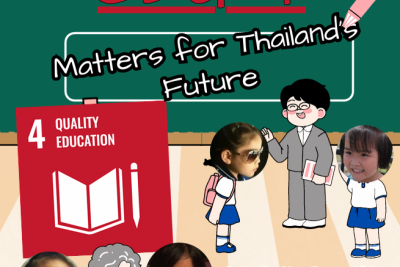
“Education is the seed from which all other goals grow.”

Survey Snapshot
– 44.4% of students said not every Thai student has access to education.
– 40.7% disagreed that rural students have the same opportunities as urban students.
– 46.3% reported their schools lacked adequate facilities and resources.
 These findings point to a bigger truth: in Thailand, the quality of education a child receives is still heavily based on geography and family income.
This is exactly what the United Nations’ Sustainable Development Goal (SDG) 4: Quality Education aims to address. The goal is not only to make education accessible but to ensure it is inclusive, equitable, and transformative—so that every child, regardless of background, receives a meaningful education that prepares them for the future.
The Thai Education Gap
Thailand has expanded access to education, but quality is uneven. Students in rural or disadvantaged areas face long commutes, outdated materials, and underfunded schools.
Technology, instead of closing the gap, sometimes widens it. Electronic devices like tablets and laptops are now essential, but many students lack them. Without access, they are left behind.
A Personal Comparison with Canada
As Thai international students now studying in Canada, we have experienced both systems. Canadian public schools are free until Grade 12, and equity is built into policies. When assignments require devices, schools provide them. Teachers design lessons to ensure no student is excluded.
By contrast, Thai students often face these challenges alone, reinforcing existing inequality.
What Students Want
Survey respondents suggested practical reforms:
– More critical thinking, less memorization
– Personalized learning based on interests
– Real-world subjects for future careers
– Greater teacher training and support
These align directly with SDG 4: Quality, Inclusive, Lifelong Education.
Beyond the Classroom
Education underpins all 17 SDGs. It breaks poverty cycles, fuels economic growth, reduces inequality, and prepares students to tackle global challenges like climate change.
Integrating SDG themes into lessons—such as using hunger data in math or gender equality in literature—encourages students to become informed, productive citizens.
Conclusion
Thai students understand the barriers they face, but these are systemic issues that limit opportunities.
Quality education is more than one goal—it is the foundation for sustainable development. By investing in SDG 4, Thailand can build a future where no child is left behind.
Content of SDGs Young Creator from URAQT Team.